Thứ Ba, 20 tháng 9, 2016

Thứ Năm, 14 tháng 7, 2016
12 Things to Do After You’ve Written a New Blog Post
12 Things to Do After You’ve Written a New Blog Post
 Editor’s note: Though much of the advice in this post still rings true today, some of the specific tools and techniques mentioned here are no longer supported by the companies that offered them. If you’d like additional guidance on how to optimize the performance of your blog posts, check out CMI’s Ultimate Blog Marketing Checklist: 57 Tips.
You’ve just finished writing a great new blog post. You’re excited that you’ve shared your ideas and expertise with the world. But what should you do next?
As we work with companies to develop a regular content marketing and social engagement routine, blogging is always key. A strong corporate blog can pay big dividends in the form of increased customer engagement and search engine rankings. But what many companies forget is the “marketing” part of content marketing.
UPDATE: Looking for more ideas? Check out 7 NEW Things to Do After You’ve Published a Blog Post.
Even Great Content Can Go Unnoticed
We would like to think after hitting “publish” on a new post that the seas will part, angels will sing and Moses will lead customers straight into our shopping carts. But that’s obviously not going to happen.
In reality, the only people who know your post is there are you and your RSS subscribers. After a while, a search engine spider will come along and your post will begin jockeying for search-engine position among the thousands of other web pages related to that same topic. Sure, your post is probably groundbreaking, but Google might not figure that out for months.
Rather than rely solely on search engines and a handful of subscribers to pump up your organic volume, content publishers need to establish syndication connections and plan for some targeted promotion to ensure that each piece of content gets noticed by key influencers and your ideal customers.
 Blog Post Promotional Tools: Your 12-Step Checklist
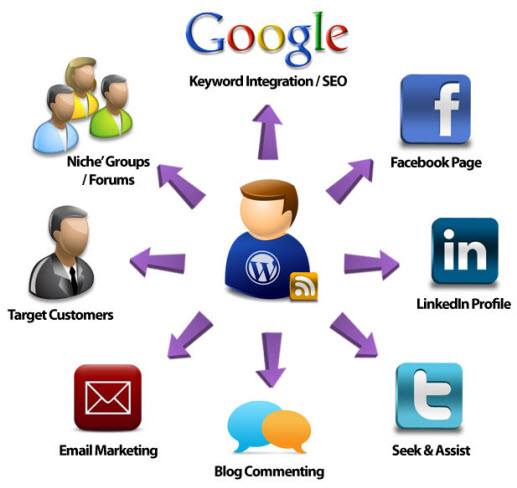
1. SEO / Keyword integration
Your content may be good as is, but a little keyword research and integration can have a big impact on search engine rankings and traffic. Scan through your content and pick out the main topics covered in your post. Plug those terms/phrases into Google Adwords’ free keyword suggestion tool. Take note of the most popular search terms and variations in phrasing and wording. Go back to your content and try to beef up your post title, content, meta description and tags with those popular terms/phrases.
2. Syndication
One of the most powerful and misunderstood mechanisms of a blog is its RSS feed. This reallysimple syndication method allows you to automatically feed your blog’s content to many different places, including many social networking sites.
Let me say that another way. When your RSS feed URL is plugged into your social networking sites or profiles, hitting “publish” on your new blog post initiates an automatic “push” of that content to those sites. This can significantly expand your reach and save you hours of time versus posting content manually.
Also note that this step is more of a one-time setup. Once you have established RSS connections on your social sites, you shouldn’t have to do it again. To get started, locate your blog’s RSS URL and plug that into the following:
Facebook Business Page – In your applications area, search for the “Social RSS” application and get it set up to publish your content to your Facebook page wall automatically.
LinkedIn Personal Profiles – Look for “Blog Link” or “WordPress” in the applications section on your profile page and set it up to auto-post your content to your LinkedIn profile. Don’t forget to tell all of your employees to do this too. If you have a lot of employees, the increase in your potential reach could be gigantic.
Plaxo – Although not as popular, Plaxo is another great business networking site that makes it really easy to “add a feed” and plug in your blog content automatically.
Ning Community Sites – If any of your fishing holes are built on the Ning platform, you can plug in your feed using the “Add RSS” widget included on your profile page.
Other Social Networking Sites – There are many other social sites that allow you to plug in your blog’s RSS feed. Scour your sites for this option.
3. Shorten your post’s URL
This step used to only apply to posting links on Twitter, but with the addition of analytics (click-through tracking) on many of the URL shortening services, posting a shortened URL on any of your social sites is a smart strategy.
Here’s how it works:
- Copy your new blog post’s URL, paste it in a URL shortener that offers analytics (Bit.ly, Ow.ly, Cli.gs).
- Use the shortened URL in any status update, link posting or teaser you plan on executing.
- Check your URL shortener account for click stats, geographic and referring site data after your link has been up a while.
4. Status updates
While this one may seem pretty obvious, it’s not that simple. Sure, you could just type your blog post’s headline into all of your social site’s status boxes, include your shortened link and call it good. But this might not get you the most clicks.
Realize that each social site is a bit different (environment, social etiquette, audience demographics / psychographics). Tailoring your status/headline for each community could make a big difference.
You also need to remember that when you post your new content via a status update, only a small percentage of your friends/followers will actually be online at that moment to see it. To maximize the likelihood of your followers seeing and reading your new post, you may need to send multiple updates on different days and at different times. You’ll also want to use different headlines each time since you may get banned from Twitter for sending the same post multiple times.
If your content covers multiple topics, create a different status update for each topic and then spread those out over the course of a few days. Don’t forget to ask your followers to share or retweet the link.
Productivity Tip: There are many tools out there that allow you to set up and schedule your updates to go out anytime in the future (Hootsuite, Twuffer, Later Bro). I’ll often schedule four to five updates with different headline variations all at once to post throughout the week.
5. Content teasers on other sites
Most social networking sites and online forums allow content promotion as long as it’s valuable, relevant to the community, and not blatant self promotion. A few examples:
- LinkedIn group forums
- LinkedIn Answers
- Facebook groups
- Ning community group forums
- Niche industry forums.
A great strategy is to write a compelling headline or question as your forum post title, then include some thoughtful commentary followed by your shortened URL. Lastly, ask for readers to provide feedback on the forum to continue the discussion.
6. Social bookmarking
While this technique doesn’t have the horsepower it used to, posting your content to popular social bookmarking sites (Digg, StumbleUpon, Delicious, etc.) can still be a great source of traffic, backlinks and overall exposure. Think of social bookmarking as peer-reviewed content. If others bookmark/digg your content, the more exposure you get and the more opportunity you have for others to link to you or reference your content on their sites.
7. Seek out and comment on other blogs with similar topics
Providing helpful, valuable comments on other blogs can be a great way to generate traffic, develop relationships, build a following and add backlinks. If you’ve just finished a blog post on a topic, now is the perfect time to do a quick search to find other blog posts on the same topic. Are the other posts lacking something that you covered in your post? Add your viewpoint in a genuine, non-self-promotional way. If the comment form asks for your website URL, paste in your blog URL.
8. Seek and assist on Twitter
Genuine assistance is one of the best ways to build a community of loyal Twitter followers. Let me use this post as an example. When it’s posted and I’ve created a shortened URL, I might jump on Twitter and do a search for a phrase like, “need help promoting my blog.” Scanning the resulting tweets will probably offer me several opportunities to help people who are reaching out for help. I reply to them with some genuine advice and the shortened URL. The result is often a new Twitter follower, a new subscriber to my blog and a blog comment. Then I get all warm and fuzzy inside…in an opportunistic kind of way.
9. Email signature
Another powerful little technique is to add your latest blog post headline to your email signature. Many email platforms now have nifty little apps (Wisestamp for Gmail) that will pull your latest blog post headline into your email signature automatically. Do it manually if you have to. You never know when a prospect, vendor or client might read a post that sparks a conversation or creates an opportunity.
10. Share your blog post with target customers
You’ve just created a blog post that you know would be beneficial for certain customers. What are you waiting for? Send them an email with the shortened URL and a note, “thought this could really help your business.” Then check the analytics to see if they clicked on it.
11. Add your blog post to your next e-newsletter
If you have an e-newsletter, you should be incorporating at least some of your blog content. Include a few post headlines/teasers and see which posts get the most clicks. You may just find that you need to do some follow-up blog posts on a topic that received a lot of clicks.
12. Ask other bloggers to mention your post
Building relationships with other bloggers in your space and asking them to blog about or link to your post can be a great way to expand your reach. Reciprocating promotional efforts can have a big payoff in the form of high-quality backlinks and big jumps in search engine rankings, blog traffic and subscribers.
The First Time is the Hardest
As with most tasks in life, the first time through this list might be tough and time-consuming. Setting up accounts and getting to know the interface and functions of the various social sites may make your brain hurt. But it will get easier. I usually dedicate an hour to blog post promotion after each launch. Also note that most of these tasks can easily be outsourced.
The key is to make this promotional effort part of your process. It’s unfortunate when I see companies put so much time and effort into creating a solid content strategy, developing their editorial process and consistently publishing great stuff, but then it just sits there. Said another way, they have awesome bait but they’ve forgotten to go fishing.
Immediate, Trackable Results
If you’re using the shortened URL and have analytics installed on your website/blog, you should see your hard work pay off almost immediately. I typically see large spikes in traffic and conversions on the days I’m promoting a new post. Multiply this by a blog post per day and that activity spike is no longer a spike. It’s now a constant. Moreover, the results should be significant increases in activity, traffic, rankings, reach, opportunities and overall sales.
How to quickly find and export all subdomains indexed by Google
How to quickly find and export all subdomains indexed by Google
Performing an SEO audit? Contributor Max Prin demonstrates how to find all of a website's indexed subdomains using a simple (and free) Chrome plugin.
Max Prin on June 15, 2016 at 9:39 am

An SEO audit is rarely limited to the www (or non-www) version of a website. When looking for potential duplicate content, it’s often important to know how many subdomains exist and, more importantly, how many of them are indexed by Google.
The good old search operators
An easy way to find indexed subdomains is to use search operators.
- Start with “site:” and the root domain.

- One by one, remove each subdomain (including: “www”) from the results with the “-inurl:” operator.

- When there are no more results for Google to return, your query with the search operators should include all subdomains indexed.
However, this technique has its limits. It’s unlikely that the site you’re auditing has as many subdomains as wordpress.com, but you may come across a site with several dozen subdomains. This can potentially cause the following issues:
- The process can be long, especially if it needs to be done for several domains.
- You might get Google “captchas” along the way.
- The size of queries is limited (around 30 keywords). Thus, if your query is too long (too many -inurl operators), you will get a 400 error page from Google.
- Once you’re done, you still need some editing to create a nice list of subdomains to work with.
The solution: a simple Chrome extension, by Google
This extension, Personal Blocklist (by Google), will make your life easier. It allows you to “block” domains from appearing in your search results.
The key here is that the extension operates at the subdomain level and stores the domains in a list.
- Once added to Chrome, start with the same “site:domain.com” search command.
- Under each result now appears a “Block subdomain.domain.com” link.

- Click on each link until your result page is empty.

- You’re almost done! Simply click on the extension icon, then “export,” then copy/paste into Excel.

Enjoy!
Some opinions expressed in this article may be those of a guest author and not necessarily Search Engine Land. Staff authors are listed here.

Build Your Content Calendar: 3 Easy Steps
Build Your Content Calendar: 3 Easy Steps
 Putting out fresh, relevant content is more than a good idea for companies — today, it’s a vital step in achieving business success. Through content, you can engage prospects and customers, boost search results for your website, enhance branding, and more. So how do you get started? It all begins with building a content calendar that is based on your overall content strategy.
Here’s a look at how to map your content to the sales cycle — for both current and prospective customers — and use this information to create a strategic content calendar.
Step 1: Look at your sales cycle
The first step in creating your content calendar is to understand the phases of your company’s sales cycle. Say you’re a commercial cleaning company. Ask yourself how people become your customers. Do they find you through pay-per-click ads on search pages? Television advertising? Word-of-mouth referrals from other clients? Talk to your salespeople and find out what your typical lead-to-conversion cycle looks like. Say it’s typically online marketing from your sales team, followed by an in-person meeting with interested parties, and then personalized sales packets that propose custom cleaning plans. You’d want to identify key demographics in the timeline, such as new leads (the people seeing your online ads), interested prospects (the people who contact you for more info), new customers, returning customers, former customers, etc. These will be the categories to which you allocate topics.
Take time to learn as much about these different areas as you can. If your new leads come primarily through online ads, spend time finding out about the prospects who respond to them. Once you’ve gathered data on these groups of clients, you’re ready to start planning the content you will target them with.
Step 2: Brainstorm topics and align them to categories
After you’ve nailed down the stages of prospects in your sales cycle, your next step is brainstorming topics for them. If you are a commercial cleaning company, think about the concerns that facility managers may have that would prompt a visit from your salespeople. For example: Are they worried about whether or not you’ll be able to manage the damage from heavy traffic in their hallways? Are they concerned about LEED certification issues? Bam! You’ve got ideas to fill your content calendar with topics that address their needs. So your list for this stage of the sales cycle might look like the following:
- Keeping Your Facility in Stunning Shape
- How to Make a Strong First Impression in Your Entryway
- What Happens When You Have a Last-Minute Cleaning Emergency
- How to Manage Weather Damage to Your Carpeting
- The Ins and Outs of LEED Certification
- Sustainable Cleaning Practices
You’ll devise lists like these for each stage of the sales cycle. Once you have exhausted all your ideas, you can move to step three.
Step 3: Set your content calendar
Pull out an actual calendar, either on paper or online, and start scheduling content into it. There are many different types of content, so don’t think the list should be only blog topics, or only email newsletters, or only pay-per-click advertising. Consider all these different types, too:
- Photos
- Videos
- Case studies
- Social media updates
- Infographics
- Charts
- eBooks
Again, talk with your salespeople to find out the best frequency, time of day, day of the week, etc., for delivering your content, and plan your content calendar accordingly. You can also ask them for their advice on building your topic ideas into useful content that will serve your audience’s needs. So, for example, your topics that cater to interested prospects might need to be seasonal (i.e., relating to different weather damage in different seasons, etc.). Consider the following factors:
- How seasonality affects your business
- Industry trends, conferences, events
- Timing of new product launches
- Company news and announcements
After you’ve taken the three steps outlined above, start putting your content into place. Write the articles, make the videos, schedule the ad campaigns, and so on. Monitor the results of your efforts, and continually refine and adjust the type and schedule of content accordingly. For example, if you see prospects are responding especially well to your eNewsletter but less to your pay-per-click ads, focus more attention on newsletter content.
There’s no better time to start
What are your thoughts on content strategy and scheduling? Have you been putting off creating a content calendar for your business because of a lack of understanding, lack of know-how, or other roadblocks? If so, it’s time to do something about it. By using the simple steps outlined above, it’s easy to put a plan into place.
68 SEO Content Tools, Trends, and Tips for B2B and B2C Brands
68 SEO Content Tools, Trends, and Tips for B2B and B2C Brands

Time-strapped, budget-conscious B2B and B2C marketers can’t afford to make unwise choices with SEO andcontent marketing.
You won’t find a do-everything-for-me software product, but you can make excellent progress by continually asking these questions:
- Am I confident that my team and I understand SEO?
- Do we have the time to shape SEO strategies and put them into motion with content marketing?
- Are we using the right third-party SEO tools and resources to support our efforts?
- How do our business objectives relate to SEO and content marketing?
- How can I best measure our ROI?
It’s tough to answer all of the questions if you aren’t sure how to deal with the first question – do we understand SEO?
Marketers love SEO because it seems like they don’t need to “pay” for the website traffic derived from SEO – at least not like they do with advertising. Most SEO expense is tied up with people resources – internal wages and fees for freelance writers and consultants.
Website traffic is critical for B2B marketers – 63% say it’s the metric they review more than any other to evaluate success, according to CMI’s B2B Content Marketing 2015: Benchmarks, Budgets, and Trends – North America. Thirty-nine percent of B2B marketers also cite SEO rankings as a key metric. Similarly, 62% of B2C marketers monitor website traffic and 39% view SEO rankings as important metrics, according to CMI’s B2C Content Marketing 2015: Benchmarks, Budgets, and Trends – North America.
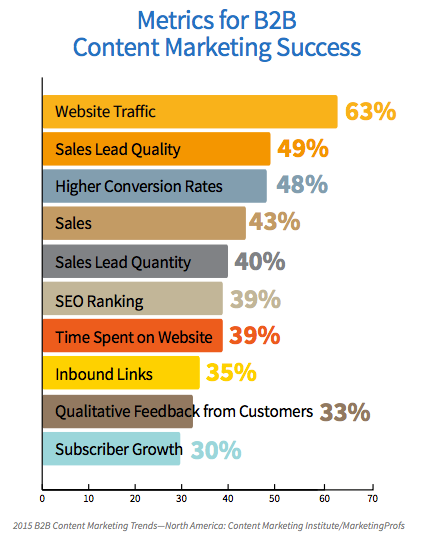
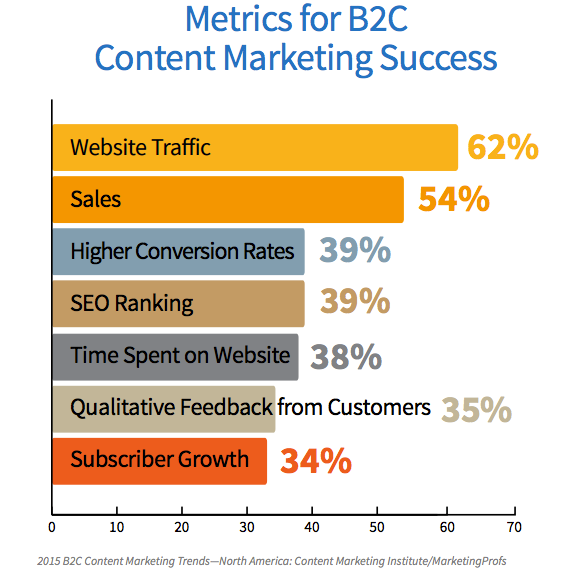
If website traffic matters to you, the following SEO tools and content marketing principles and tips can help you make good decisions and use your marketing dollars well.
What does your website bring to the table?
You can research keyword phrases all day, but ultimately the chosen words and phrases will make the difference.
Some business executives with whom I speak honestly believe they can just pick whatever words appeal to them. They shouldn’t. Keywords should be selected based on your website’s strengths and weaknesses, including how well they match keyword relevance, and searcher intent, including:
- Existing content
- Planned content
- Website age
- Domain name (It helps to include a keyword or phrase.)
- Website structure (whether search engines can index the content)
- Page URLs (Use dashes to separate three to five words.)
- Inbound links
- Ability to add SEO page titles
- Meta descriptions (helpful if they include clear calls to action)
- Amount of website traffic for competitive keywords (Google Webmaster Tools provides some details you might not see in Google Analytics.)
- Relevance of keywords used to reach your website
- Current rankings (Your website’s ability to rank well for keywords will affect your SEO strategy.)
- Website design and navigation (including mobile)
- Calls to action (to leverage organic and other traffic)
Go low and grow keywords
Should you use a keyword phrase that receives 10,000 monthly searches or 2,000? Sometimes, you’re much better off using a keyword phrase searched less than 2,000 times a month – and maybe even as little as 100 to 500.
Given the number of other results on a search engine page, you might think that low search traffic for a keyword phrase is not likely to generate any website traffic. But you’re not just targeting one phrase in your content.
Even if you focus on something like “CRM solutions,” the presence of that phrase and other words on the subject in the content itself can give rise to any assortment of keyword phrase searches, including synonyms and close variations.
It simply doesn’t make sense to pursue a keyword phrase that’s searched 5,000 times when you don’t even rank No. 199 for it today. Could you pull it off? Sure. It may require several pieces of related content, not just one article.
For keyword research, use SEO tools like Google’s Keyword Planner through AdWords,Keyword Discovery, or Wordtracker as well as other specialized tools like Übersuggest andSECockpit.
The following example from Google’s Keyword Planner offers a sense of how often some keyword phrases related to CRM software are used and how suitable they may be for a business.

Pay a writer
Whether you rely on in-house talent or freelancers, you need someone to write SEO contentthat can be reused in email, social media, SlideShare presentations, etc. Good copywriters don’t just write well; they shape and guide content.
SEO titles
You can enter 72 characters including spaces in a page title. Don’t waste them by using your company name or a navigation label like Our History. Use keyword phrases in the title.
You still can separate keywords with commas, but using a headline format is more common (and looks better, too, when SEO titles appear among the search engine results and social media). Maybe take a blended approach. I sometimes use SEO phrases after a colon. It’s an easy way to showcase the most critical phrase early in the SEO title. Here are a few suggestions (primary keyword phrases in bold):
- Bathroom Vanities for Your Home (The presence of “home” can help produce other high rankings for a number of keyword phrases.)
- Sweaters for Women: Women’s Clothing, Tops
- Compression Molding Presses: Powder Compacting, Heated Platens
Longer writing
I get that some marketers hesitate to fill pages with too many words because they don’t want to turn off website visitors. Or they fear that the content will educate the audience too much and give them no reason to call or complete a contact form. But long content can complement the design. If your content is short, search engines aren’t as likely to rank it well.
Based on your SEO-related business needs, you can focus on several writing options, including:
- Write short, hope for the best.
- Write long and break up the text about your products and services with notable quotes, subheads, images, charts, etc.
- Mention calls to action high on the page.
- Create a growing set of how-to evergreen articles on specific topics that target specific keywords.
Years ago, online marketers favored a minimum of 250 words per page, and then consensus seemed to be 500. Lately, experts say at least 1,000 words are needed to maximizeSEO content – which is what I recommend, too.
Work your target keyword phrase into the SEO title, the URL, on-page headline, and throughout the content. Find natural opportunities to incorporate the phrase (no need for overkill).
For more data and insights, check out The Ideal Length for Blog Posts, Tweets, and Everything Else in Your Marketing.
Seek inbound links
It’s frustrating to hear over and over that you just need to create great content and SEO will take care of itself. It’s naïve. Your content must be pitched or found before anyone can think about sharing it. Only a few people may see your original 1,200-word blog post if you’re not using a keyword phrase that your website’s authority is strong enough to support. You can help influence your website’s search rankings over time by obtaining links to your site from other sites.
I’m a big fan of Neil Patel, co-founder of Crazy Egg and KISSmetrics. He’s effective at creating content that attracts links.
He’s a master at SEO, link building, and all things marketing. On his Quick Sprout blog, you’ll find countless posts that generate links, SEO rankings, and thousands of comments. He also attracts links by showcasing infographics and extensive guides like The Definitive Guide to Conversion Optimization.
Like Neil, your team can create valuable content that people will want to share.
Here are some simple ideas that may inspire you to create content that people may link to from their blogs and other websites.
You can present them as long blog posts or other website content that’s immediately available to visitors. Or, take these or other concepts and turn them into a four-page PDF that anyone can download if they provide a name, email address, and phone number. Although a PDF can be gated content, you can improve your odds of ranking well by including a free excerpt (or several excerpts) that can be indexed by search engines. Consider maximizing your content by summarizing key points in an infographic that others might link to from other websites.
The following suggestions may help you think of some content topics that you can develop to encourage others to link to your website.
B2B Content Ideas for SEO
- Manufacturing in 2015: Best Insights, Tips and Innovations
- 12 Ways Businesses Fall Short With Investment Strategies
- How to Put the Best Applicant Tracking Systems to Work
B2C Content Ideas for SEO
- 10 Best Holiday Travel Destinations for Families in 2015
- Don’t Buy the Fitness Hype: Set Your Pace with Practical Meals, Exercises
- Gone Forever? 20 Fashion Trends from the ’60s, ’70s, ’80s, and ’90s
To influence SEO, you can build inbound links by:
- Promoting your content through websites, email campaigns, social media, advertising, and business relationships
- Writing for online publications (Get a link to your full piece or bio.)
- Registering with industry online directories
- Reaching out to influencers (see 6 Tips for Influencer Marketing from an Influencer)
- Asking related blogs, newsletters, and magazines to link to your content
- Reviewing competitors and other websites to scope out the link sources they already found and following up with those sites to post your content (If you’re researching competitors and industry websites, the MOZ Open Site Explorer is a good place to start.)
Measure SEO the right way
Some businesses still look at search engine rankings to define part of the ROI. I check search engine positions to chart progress in view of other data, but it’s not the best way to assess ROI. Here are some suggestions on how to measure SEO effectively after you establish search engine visibility, visitor, page view and other performance goals:
- Create a how-to guide for SEO as it relates to content marketing and track how many leads are created in a year. You can even assign a value to each lead by estimating how many leads are needed to land a sale. For example, if it takes 20 leads to close an average $10,000 sale, each lead is worth $500.
- Tie your efforts to marketing automation products like HubSpot, Marketo, Act-On software, and Infusionsoft, which help grow and manage details about new and existing email contacts (including whether new leads are based on organic searches).
- Leverage Google Analytics to track your response forms, e-commerce, and more.
- If you’re not collecting an email – and simply giving away content – you can still monitor a website PDF and other downloads through Event Tracking.
- Use call tracking services offered by Mongoose Metrics, Marchex, LogMyCalls, and others that can tie calls to organic searches.
Use tools for technical and competitive analysis
Brands can get insights about SEO trends and capabilities of major enterprise SEO tools and platforms with this free gated resource, Market Intelligence Report: Enterprise SEO Platforms 2015: A Marketer’s Guide. It’s a good way to size up leading vendors that help marketers manage, understand, and use vast amounts of SEO data.
Other useful SEO tools include:
- Screaming Frog SEO Spider
- Moz
- SEMrush
- SheerSEO
- Majestic SEO
- SEO Site Checkup
- WooRank
- Ahrefs
- Keyword Tool
- KWFinder
- Google Mobile-Friendly Test
Here are some additional perspectives on search engine optimization:
- The Ultimate SEO Checklist: 15 Steps to Optimize Your Content Marketing Plan
- 10 Most Common SEO Pitfalls
- 14 Checklists, Scorecards, and Worksheets to Set Up Content Marketing Success
- More than Keywords: 7 Concepts of Advanced On-Page SEO
- A Visual Guide to Keyword Targeting and On-Page SEO
- Don’t Ignore SEO Strategy in Favor of Content
What techniques and tools work best for you? How do you set and revise your SEO content strategies based on what you need to accomplish?
Want to expand your content marketing best practices? Start with these two free e-courses, which are part of CMI’s comprehensive Online Training & Certification Program. It contains over 19 hours of must-know strategies, tactics, and best practices, delivered by leading experts. Sign up now.
Cover image by Joseph Kalinowski/Content Marketing Institute
Please note: All tools included in our blog posts are suggested by authors, not the CMI editorial team. No one post can provide all relevant tools in the space. Feel free to include additional tools in the comments (from your company or ones that you have used).
Đăng ký:
Bài đăng (Atom)